

The Project's Learning Objectives
The NESHAMA project is designed to make Holocaust remembrance a living part of European education and civic culture. By combining historical knowledge, local engagement, and a European perspective, it empowers young people to become active transmitters of memory, critical thinkers, and committed defenders of democratic values.
Through their engagement with remembrance sites, online and in-person events, and peer-to-peer learning, Young Holocaust Ambassadors are prepared to carry forward the voices of Holocaust survivors at a time when so few remain to tell their stories.
Share


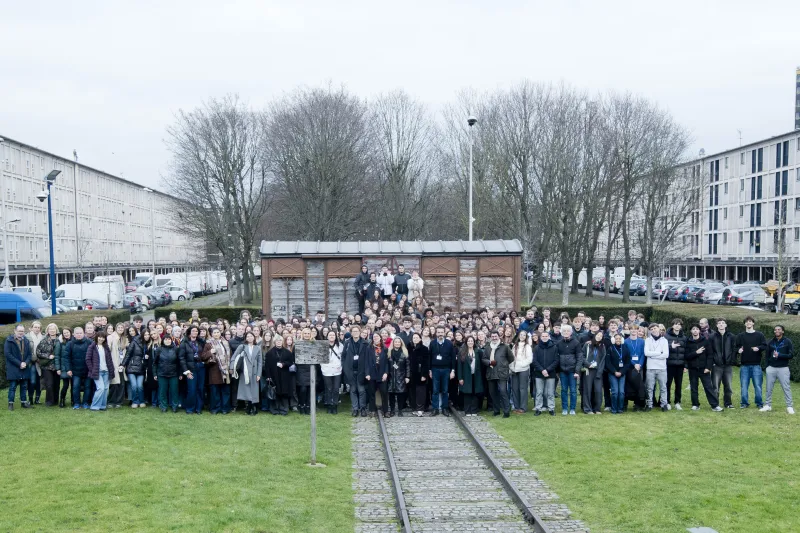
The NESHAMA project is built upon a comprehensive pedagogical ambition: to ensure that the memory of the Holocaust remains a living, meaningful, and active component of European civic culture. At a time when the last survivors of the Holocaust are disappearing, NESHAMA seeks not only to preserve memory, but to transform younger generations into conscious and responsible actors in its transmission. Its educational objectives therefore combine historical knowledge, ethical reflection, civic responsibility, and European awareness within a structured and multi-layered learning framework.
1. Ensuring the transmission of Holocaust memory
At its core, NESHAMA aims to guarantee that the memory of the Holocaust does not fade by formalizing a European network of remembrance sites and creating a generation of young Ambassadors of Holocaust Remembrance. Inspired by UNESCO's definition of Holocaust education as the historical study of the systematic, state-sponsored persecution and murder of six million Jews by Nazi Germany and its collaborators, the project goes beyond remembrance as commemoration. It promotes Holocaust education as a critical tool for understanding the mechanisms of exclusion, discrimination, antisemitism, and dehumanization that led to genocide.
By engaging students in sustained contact with sites of remembrance and with survivors or major witnesses of the Holocaust, NESHAMA enables them to become "witnesses of the witnesses." This intergenerational approach provides one of the last opportunities for vivid, direct transmission and ensures that memory is not abstract but embodied and personal.
2. Developing a multi-scalar and embodied approach to history
A distinctive educational objective of NESHAMA is to promote an embodied appropriation of Holocaust history through a dual structure: local anchoring and European perspective.
Local and national level
At the local and national level, each group of Ambassadors is partnered with a site of remembrance in its country. Through site visits, workshops, meetings with professionals, and educational sessions, students gain a thorough understanding of the history, mission, and contemporary role of their remembrance institution. They explore the Holocaust within the specific context of their country while discovering Jewish life and culture in their region, both before and after the genocide. When relevant, they are also encouraged to reflect on the fate of other persecuted groups. This local anchoring allows students to perceive the Holocaust not as distant history, but as part of their own national and territorial heritage.
European level: four joint theoretical training sessions
At the European level, four joint theoretical training sessions provide a broader and comparative perspective. These sessions address:
- An introduction to the Holocaust in Europe and the NESHAMA framework;
- A gender perspective on the Holocaust;
- Jewish life and culture in Europe before the Holocaust;
- The evolution of remembrance policies in Europe.
Through these sessions, conducted collectively and in English, students move beyond national narratives and develop a shared European understanding of the Holocaust. This transnational dimension reinforces the idea that the Holocaust is both part of each country's history and a central element of Europe's collective history.
3. Strengthening critical thinking and civic awareness
Holocaust education within NESHAMA is designed to cultivate critical thinking and democratic vigilance. By examining how political regimes and institutions can be undermined and turned against segments of society, students learn about the fragility of democratic systems and fundamental rights. The study of antisemitism as the ideological driver of the Holocaust is also linked to broader reflections on racism, intolerance, propaganda, extremist ideologies, and the abuse of official power.
The programme encourages Ambassadors to connect historical analysis with contemporary challenges, including online hate speech and antisemitic discourse. Specific training components help them develop analytical tools to recognize warning signs of mass atrocities and discriminatory rhetoric. In doing so, Holocaust education becomes a gateway to broader reflection in philosophy, sociology, political science, and human rights education.
Furthermore, by highlighting the international legal and institutional frameworks developed after the Second World War, including the United Nations system and human rights conventions, NESHAMA reinforces awareness of the norms and institutions designed to prevent future atrocities. This contributes to strengthening students' sense of European citizenship and their attachment to democratic values.
4. Fostering peer-to-peer transmission and youth leadership
NESHAMA is innovative in positioning young people not merely as learners but as key actors in memory transmission. By training them as Ambassadors, the project capitalizes on their creativity, communication skills, and leadership potential. After an initial phase of knowledge acquisition, Ambassadors are encouraged to implement remembrance initiatives within their schools, communities, and digital environments.
Peer-to-peer education is central to this objective. The creation of successive "promotions" of Ambassadors and the introduction of a mentor status ensure continuity and sustainability. Digital tools, private online platforms, and potential media initiatives such as podcasts further amplify their engagement and visibility. Through this dynamic network, NESHAMA builds a vibrant European community committed to remembrance, tolerance, and dialogue.
5. Promoting a European culture of remembrance and responsibility
Ultimately, the educational objective of NESHAMA is not limited to historical knowledge. It seeks to cultivate a shared European culture of remembrance rooted in respect for human dignity, solidarity, and resistance to hatred. By progressively expanding across EU Member States, the project contributes to building transnational synergies among remembrance institutions and addressing the persistent gaps in Holocaust and Jewish life education across Europe.
Through its multi-scale structure, local, national, and European, NESHAMA enables students to understand that the Holocaust belongs simultaneously to their own country's history and to the collective history of Europe. In becoming European Ambassadors of Remembrance, they become guardians not only of memory against oblivion and trivialization, but also of the democratic values that constitute a safeguard against the return of such barbarity.