

Class of 2025-2026
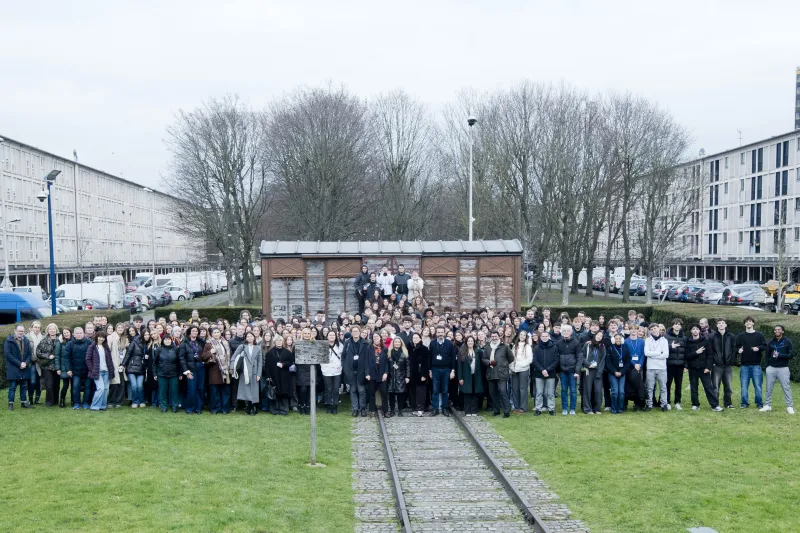
The 2025–2026 cohort of NESHAMA brings together students and educators from five countries, six sites of remembrance, two public institutions and thirteen schools across Europe, forming a dynamic network dedicated to Holocaust remembrance as well as Jewish life and culture. Through a structured educational pathway, students strengthen their critical thinking skills and deepen their understanding of the processes that led to the destruction of democratic values and human dignity, culminating in the annihilation of European Jewry. As young Ambassadors of Remembrance, they are empowered to stand up against antisemitism, discrimination, prejudice and all forms of intolerance.
Share


Project coordination and EU grant management
Coordinated by the Shoah Memorial, the programme ensures long-term sustainability, sound management of the EU grant, comprehensive documentation of activities, and a shared communication strategy across the consortium.
Participating schools and countries
The cohort includes students from:
- Croatia:
16th Gymnasium Zagreb - France:
Lycée Charlemagne, Paris
Lycée Joliot-Curie, Nanterre - Germany:
Berufsbildende Schulen J.P.C. Heinrich Mette, Quedlinburg, Saxony-Anhalt, Germany - Greece:
Greek-French School "Saint-Paul" in Athens
6th Lyceum of Volos - Poland:
Konarski High School in Oświęcim
Upper Secondary and Technical Schools Complex named after Ignacy Łukasiewicz in Oświęcim
Economic and Gastronomic Schools Complex in Oświęcim
Technical School named after Professor Kazimierz Bielenin in Brzeszcze
Maria Dąbrowska High School in Kęty
Mechanical and Electrical Schools Complex named after Nicolaus Copernicus in Kęty
Stanisław Wyspiański High School in Kęty
2025–2026 educational calendar: online and in-person sessions
The 2025–2026 calendar combines online and in-person learning experiences, offering participants a progressive and comprehensive educational journey. The programme included nine online sessions, beginning with training sessions hosted in Greece in September 2025, followed by online testimonies and thematic discussions organised by partners in Germany (October 2025), Croatia (December 2025), and France (April 2026). These digital activities were complemented by two international in-person meetings, held in Paris and at the Auschwitz-Birkenau State Museum, which provided participants with the opportunity to visit major sites of Holocaust remembrance, engage directly with experts and witnesses, and strengthen the connections established throughout the project. Together, these complementary formats enabled the young ambassadors to deepen their historical knowledge, exchange experiences across borders, and develop a shared commitment to Holocaust remembrance and the fight against antisemitism.
Over the course of several months, participants in each participating country became familiar with the history, mission, and activities of their respective partner institutions. Through on-site visits and active participation in a range of educational and commemorative initiatives, they developed a deeper understanding of the institutions' role in preserving Holocaust remembrance and promoting historical awareness.
The programme included a series of online courses led by historians and experts in Holocaust studies and European remembrance with an opening session delivered by Hubert Strouk (May 2025), a lecture by Lisa Pine exploring a gender perspective on Auschwitz-Birkenau (November 2025), a presentation by Joël Kotek on Jewish life before the Holocaust (March 2026), and a session with Alban Perrin focusing on remembrance policies in Europe (May 2026). These conferences provided participants with a broad range of perspectives on the Holocaust, its historical context, and the ongoing challenges surrounding remembrance in Europe.
European Youth Holocaust Ambassadors Event 1st Edition (Shoah Memorial in Paris, Drancy and Bobigny)
In January 2026, participants gathered in Paris for a series of study visits at the Shoah Memorial (Paris and Drancy), the Mémorial des martyrs de la Déportation, the former Drancy internment camp, and the former railway station of Bobigny.
The programme also included a live testimony by Arlette Testyler, a lecture on Jewish women’s resistance, and a dedicated educational event connected to the Auschwitz-Birkenau State Museum. Alongside these educational activities, participants took part in several commemorative ceremonies, including a ceremony held at the Shoah Memorial on 27 January, International Holocaust Remembrance Day, as well as a ceremony to rekindle the Flame of Remembrance under the Arc de Triomphe.
Student projects: transmitting remembrance through creative work
During this first in-person meeting, each delegation presented a project reflecting its site of remembrance and engagement in NESHAMA:
a student film for the Mémorial de la Shoah; a “trailer”
a style presentation for the Mémorial des martyrs de la Déportation;
a historical presentation on the Gedenkstätte Langenstein-Zwieberge;
a film and object-based reflection presented with the Auschwitz-Birkenau State Museum;
a student-produced film for the Jasenovac Memorial Site;
a creative reconstruction of forged identity papers by students working with the Jewish Museum of Greece.
Together, these initiatives embody the spirit of NESHAMA: learning, transmitting, and actively carrying remembrance into the future.
European Youth Holocaust Ambassadors Event 2d Edition (Oświęcim)
From 15 to 17 March 2026, the young ambassadors of remembrance from the NESHAMA project gathered in Oświęcim for the second international in-person meeting of the programme. This meeting represented a key milestone in their year-long journey, providing an opportunity to deepen their understanding of the Holocaust through direct engagement with one of the most significant sites of remembrance in Europe.
During this encounter, participants followed a comprehensive study programme at the Auschwitz-Birkenau State Museum, including guided visits to the former Nazi German concentration and extermination camp sites of Auschwitz I and Auschwitz II-Birkenau. Through these visits, they explored the history of the camp, the mechanisms of persecution and mass murder implemented by Nazi Germany, as well as the challenges of preserving and transmitting the memory of the Holocaust today.
The meeting concluded with a diploma ceremony celebrating the commitment and engagement of the young ambassadors throughout the NESHAMA project. The certificates were presented by Piotr Cywiński, Director of the Auschwitz-Birkenau State Museum.