

European delegations attends the Holocauste rememberance Day commemorations in Brussels - January 21 2025
On 21 January 2025, in Brussels, the European Commission, in partnership with the Polish Presidency of the Council of the European Union, organized the Holocaust Remembrance Conference: Remembering the Past, Shaping the Future to mark the 80th anniversary of the liberation of the Nazi death camp Auschwitz-Birkenau and International Holocaust Remembrance Day.

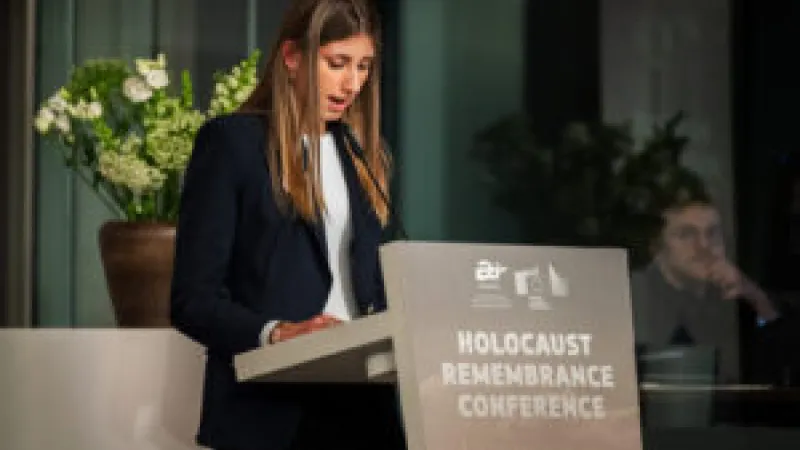
The event brought together institutional representatives, Holocaust survivors, Jewish organizations, and European delegations committed to preserving the memory of the Shoah. In a video message, European Commissioner for Internal Affairs and Migration Magnus Brunner emphasized that “the future of our democracy depends on our collective ability to remember and learn from the past.” Holocaust survivor Mala Tribich shared her testimony in a conversation with Katharina von Schnurbein, while Władysław Teofil Bartoszewski and Raya Kalenova also addressed the conference.
Young European ambassadors of remembrance from the Neshama programme, representing Croatia, France, Germany, and Poland, read excerpts from testimonies and literary works related to the Holocaust. Among them were the French ambassador Martin Pallu de la Barrière, the German ambassador Radoslav, who read an excerpt from Panorama by H. G. Adler, and the Croatian ambassador Eleni Šijaković, who presented the testimony I Wanted to Fly Like a Butterfly by Hannah Gofrit. Musical interludes featured pieces composed in the Ravensbrück camp and the Łódź Ghetto. The conference concluded with a commemoration ceremony led by Rabbi Olivier Kaufmann, who recited the El Malech Rachamim and the Kaddish, followed by the lighting of candles in memory of the six million Jews murdered during the Shoah, as well as the other victims of the Holocaust, including Roma people, persons with disabilities, and members of the LGBTI community. The participation of the young ambassadors illustrated the central objective of the Neshama project: to empower young people across Europe to become active ambassadors of Holocaust remembrance and to help preserve this memory for future generations.